Do I Need an Enclosure?
You need an enclosure if you print ABS, ASA, or PC — all three have high warping/shrinkage and benefit strongly from a stabilized chamber temperature. You do not need one for PLA, PETG, PLA+, or TPU, which have low-to-moderate warping and print reliably in an open frame. An enclosure's job is temperature stability, not fume safety — pair it with real exhaust/filtration if ventilation is your concern.
Enclosure need by material
| Material | Enclosure needed? | Warping class |
|---|---|---|
| PLA | No | Low |
| PLA+ | No | Low |
| PETG | No (mild warping only) | Low–moderate |
| TPU | No | Low |
| ABS | Yes, strongly recommended | High |
| ASA | Yes, strongly recommended | High |
| Nylon (PA) | Yes, recommended | High |
| PC | Yes, required | High |
Full material dataset: The 3D Printing Numbers.
What an enclosure actually does
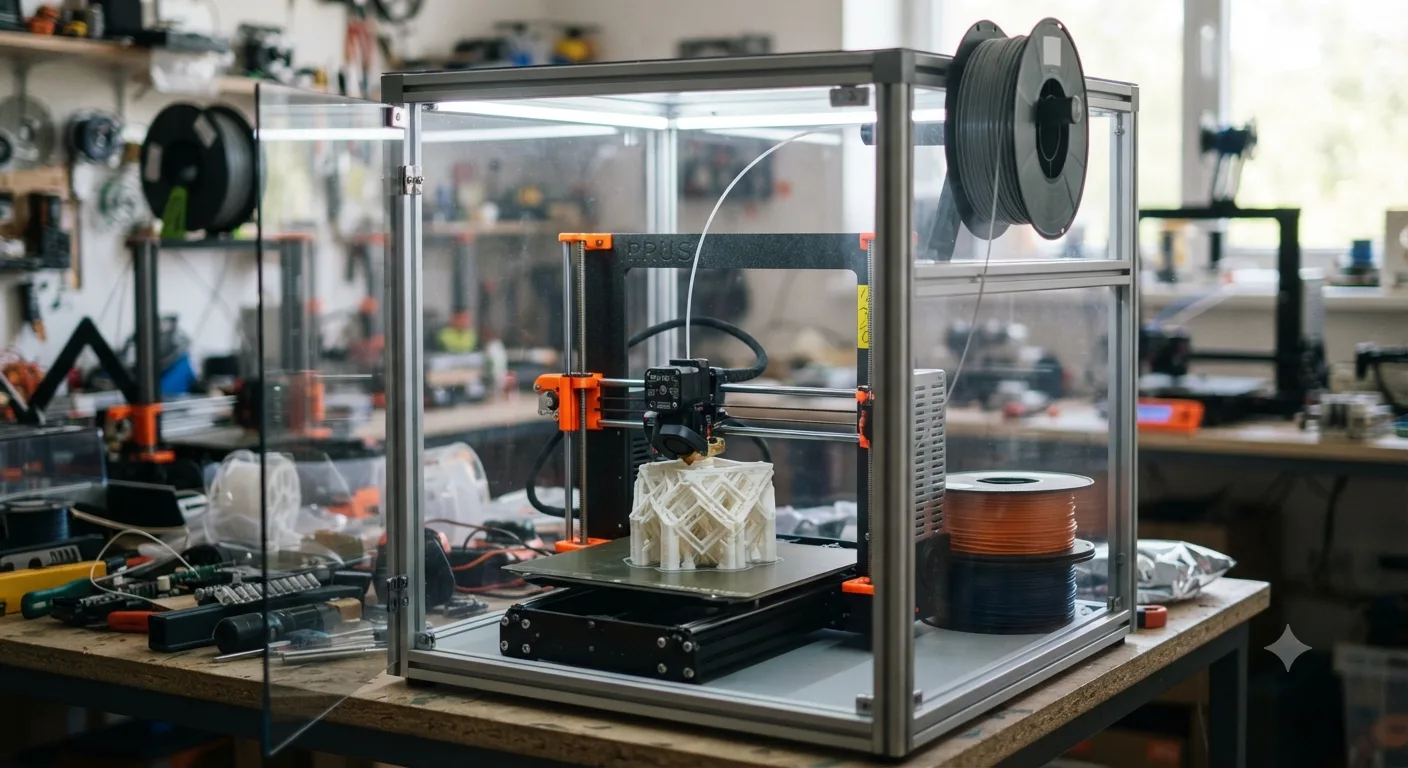
An enclosure stabilizes ambient chamber temperature around the print, which reduces the uneven cooling that causes corner-lifting and layer-splitting on high-shrinkage materials like ABS and ASA. It is a thermal tool, not primarily a safety tool — a passive (unheated) enclosure raises chamber temperature only modestly above room temperature.
Enclosure vs ventilation — different problems
ABS and ASA emit noticeable fumes (styrene-related) during printing. A sealed enclosure with no airflow control can concentrate those fumes rather than remove them. If ventilation is your concern, pair any enclosure with active exhaust to outside air or a filtered fan setup — not sealed containment alone. See the fume/ventilation notes column in The 3D Printing Numbers for material-by-material guidance.
Frequently Asked Questions
No. Both have low-to-moderate warping and print reliably in an open frame in a normal room. An enclosure is not required for either material.
Not by itself. An enclosure's main job is stabilizing chamber temperature to reduce warping. For actual ventilation, pair it with active exhaust/filtration or open-window airflow — a sealed enclosure without airflow control can even concentrate fumes rather than remove them.
It helps meaningfully with warping compared to a fully open frame, but a passive (non-heated) enclosure raises chamber temperature only modestly. In a cold room, ABS/ASA may still need additional draft-proofing or a heated enclosure for consistently warp-free large prints.
ABS, ASA, and PC all benefit strongly or require one due to high warping/shrinkage tendencies. PLA, PETG, PLA+, and TPU do not need one for warping control.